Showing posts with label Conservative Party. Show all posts

Friday, 9 July 2010

New Labour and the universal welfare state

This is the sort of thing I've been talking about for a fair amount of time - Labour putting people on to the public payroll, welfare state (i.e. getting tax credits when you earn £50k a year etc) - and there's an admission from one of their side (Sunny Hundal), calling it their 'greatest achievement' (emphasis mine):

And so, expanding the size of the welfare state and making it central to people’s lives, despite Thatcher’s best attempts to destroy it, was one of New Labour’s greatest achievements. And by that I mean expenditure on the NHS, on public transport, on public works, on the arts and of course on unemployment benefits.

The welfare state is key to the success of economic redistribution. And in order to maintain popularity for the welfare state it has to fulfil two criteria: it has to be universal; and it has to improve people’s lives to the point they feel they have a stake in it.

The Tories need to shrink the state for ideological reasons because the less people have contact with it, the less they’ll support it.

Ignoring the anti-Thatcher nonsense, I think this hits the nail on the head about the modern difference of Labour vs. Conservative - both support some form of welfare state, but the conservative welfare state is a safety net (as originally intended by Beveridge) while Labour's is more of a hammock, trying to make everyone feel an allegiance to it, even if it is literally taking money out of one pocket, and putting most of it into the other pocket (minus, of course, the stuff dropped on the floor as government waste).

And there was an essay in the Spectator just after the Budget, saying that Osborne wanted to move people off the welfare state to make them more self-reliant, and therefore more likely to vote Conservative.

And this is probably the key difference. It's all quite political, which isn't great, but the conservative way is to move people off the state payroll (be it direct employment or in the form of tax credits, etc) to make them more self-reliant, make them more likely to want things like corporation tax cuts and lower regulation, etc - i.e. vote Conservative. Labour's way is to move people on to that state payroll, encourage state dependency - and in that create 'client states' (see Glasgow) of people who will not vote to remove this, because it seems comfortable, it seems nice and plush, even though they are actually paying (and, since it discourages work, probably paying even more than without tax credits etc) to subsidise themselves. In short, they want people to vote Labour.

And that is a key ideological divide between the Conservatives and Labour. Modern conservatism, especially IDS, seem to see a role of government in helping people to stand on their own two feet, and not be dependent on government - and though my more libertarian strands question whether this approach is best, it is certainly a noble aim - and more noble than the idea of making people dependent on government - it's hardly helping them, and it's hardly providing any freedom.

And that's probably part of the reason that I'm a conservative - getting people off the state payroll, and to coin a phrase that a fellow canvasser said back in April, encouraging social responsibility not state dependency. It's not rabid individualism, it in fact lets people decide if they want to be self-reliant or if they want to help each other out (the social responsibility part of that phrase I just mentioned) - and I think families and communities, families especially, are incredibly important in this. I just don't think that state dependency is at all responsible, at all fair or at all helpful. The state is faceless, impersonal and doesn't generally have a clue.

A return to the Friendly Societies? No, I'm getting too optimistic.

Monday, 10 May 2010

Could the Lib Dems split?

Over all these deals? It's already a coalition as it is (a merger of the old Liberal-SDP alliance) - so what if the Orange Bookers, the old Liberals (Laws et al) left and went across to the Conservatives, who share some of their Whiggism if we are to go back that far, while the lefties went across to Labour, who they seem to think are their "natural partners"?

And the UK returns to two-party politics, with no need for electoral reform?

Just a thought.

Friday, 7 May 2010

Cameron should not form a formal coalition

No, no coalitions. An implicit deal, yes, but not a formal coalition. There are areas of common ground, the sort of legislation we can push through with the votes (or abstentions) of LibDems. Might help push an emergency budget through, since that being blocked could lead to financial meltdown.

Yes, there are disagreements, electoral reform being one of the major ones - why not put it to the House? We have legislators for a reason, they just aren't used properly enough. And in fact the 2010 Conservative manifesto had something of an old Liberal feel about it - might some Lib Dems actually feel comfortable with a good lot of what's in the manifesto?

As for electoral reform, I'll talk about that in a future blogpost. But it's probably worth Cameron going it alone, getting some stuff through, showing he's serious and he's taking the decisions, then calling a second election. But first, he also needs to sell conservatism to a sceptical public, sell the fact that government is not the answer to everything.

(in other news today, a load of youngish (7-11) kids decided to jump on me and make lots of noise because I said I voted Conservative. The poor souls seem to think voting Labour/Lib Dem is better for unemployment, or is somehow 'helping the poor'. They're young, I'll let them off.)

Monday, 19 April 2010

Saturday, 17 April 2010

Campaigning in Newport West

Went out canvassing for the first time this morning, in Malpas. Interesting to see how many conservatives there are out there - and many "anyone but Gordon Brown" voters. Malpas doesn't strike me as a particularly friendly area for us, but it seemed to be - apparently one of the more marginal bits (well, compared to Bettws and Pill, maybe it is).

Another interesting thing is that I didn't personally find a single Lib Dem voter, and of all of us, there weren't many there. So this resurgence is nonsense to me.

It's target seat #117, so needs to be won for a Conservative majority in Parliament. Flynn seems to be treating it as something of his safe seat from what I've seen; let's hope not.

Tuesday, 13 April 2010

The Conservative manifesto

First of all, apologies for not posting in months - A levels are soon and they tend to take up my life. Since as of yesterday I'm of voting age, I thought I should probably check the two manifestos out.

The Conservative Party manifesto; plain on the cover, but inside of it something else. For too long, "they are all the same" has controlled the mainstream argument (as has "the Tories haven't changed", blah blah). The manifesto today, for me, disproved it. It shows a distinct difference between the Labour approach and the Conservative approach; Labour favour the big government solution, while the Conservatives look for less government, power to people, the responsibility approach, and yes LibDems, the DIY approach!

That is inherently the conservative way. For too long, and for 13 years under New Labour, government has grown larger and larger, inheriting roles that people and society should have taken up, taking more people on to the payroll, be it the bloated public sector, the expansion of tax credits to the middle classes, and whatever else - and taking away these things seems politically unthinkable. We have a new interest group that, ignoring economics and the basics of opportunity cost, has been paid to support this larger state. And it's time that it changed, we got back to a British model, where government does less and people do more.

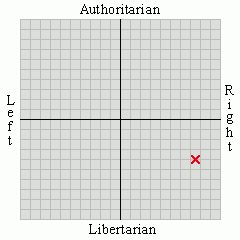
And for all the "One Nation" talk of this, it suits the libertarian-conservative Welshman in this corner. Though I have my qualms with some of the training "community organisers", protecting NHS spending and whatnot, there are some inherently conservative things in this manifesto. Take free schools (which should settle a few votes), freeing schools up, taking away the targets and looking for diversity and innovation - what's wrong with the postcode lottery if it leads to us finding a better way? I'm not sure how much there's a link between government and society in this manifesto, and I'm hoping they are made quite separate, but for people to do more and to organise themselves without government is certainly something I can support. A model of individuals controlling their own lives and doing things themselves, without government pretending it's a charity, organiser, planner, or anything else? Fantastic.

I was concerned that we'd lost conservative principles, that Cameron wasn't a conservative, and so on. Seeing this manifesto today, however much I'd like to see some of the main policies highlighted in there (but that's just a presentation issue), I know quite clearly who I should vote for. This manifesto should win the election; it sets out a different vision for the future. Whether people see that, overcome their prejudices, the "all the same" nonsense, fringe parties and so on, will probably decide this election.

Thursday, 4 February 2010

Fraser Nelson on Cameron and the Conservative Party

Fraser Nelson hits the nail on the head with this article in the Times (as a follow-up to his Keith Joseph Lecture, readable here - I recommend it).

Truly to take power, he said, one had to set the terms of debate. He had a phrase for it: the “verbal snares” that Labour sets for Conservatives. If a Tory party takes power yet uses Labour’s language, judges success by Labour’s yardsticks and confines itself to Labour’s ambitions, that’s not change. It’s more of the same.

He's got it right - Cameron seems to shudder every time a criticism of conservative values comes in (generally in defunct New Labour newspeak) and I'm not totally sure what the Party currently stands for. The Conservative Party needs to embrace conservative ideology and conservative values, not Labour values. The schools reform is a start, but this needs to be our attitude to governing.

One thing I found interesting was his link to Ted Heath, who got booted out but whose manifesto was then delivered by Thatcher. I might just be speculating, but could Cameron be a Heath, who then gets replaced by a 'proper' conservative after a one-term government? Daniel Hannan comes to mind, but I doubt it (he's more of a libertarian anyway). On second thoughts, even David Davis?

Cameron needs to start being a radical conservative (however much that phrase sounds like an oxymoron). Stop using Labour's language, Labour's ideas, Labour's values, and give a real change, a conservative change, a change that supports people and really transfers power to them, not just some words that actually create more state power.

Read Fraser Nelson's speech. He's got it spot on.

Sunday, 31 January 2010

Broadband and the Conservative Party

According to the BBC, the Conservatives are looking to install 100Mbps broadband in most homes by 2017, and fund this for rural areas where it may not be profitable to supply by the licence fee.

Internet is good, broadband even better. It has revolutionised the way we work. That is the reason it has spread - it has huge benefits that outweigh the costs. In fact, some people pay for high-speed broadband to be wired to their house, at a cost of several thousand, to make their houses worth more (according to the Economist, I think). That's the market at work - and it's done the job well, and is still doing the job well.

The first issue to grasp is why rural areas don't have broadband - not profitable to supply. That's fair enough - if you live in a rural area, that's a choice you make - you tend to be rich enough to choose to, so the government shouldn't be subsidising your broadband. Rural area or broadband, that's the choice.

It's not government's place to be involved in broadband, TV, etc - simply because of all the old arguments about not knowing individuals' needs. Sell it all off, that includes the BBC and Channel 4, abolish the licence fee, etc. No need for the government to own it. And not only that, but if we allow government to pay for the broadband (even if it is with our own money), we hold ourselves open to government saying they should be able to control what goes down those cables.

Monday, 30 November 2009

Corporation tax

According to Michael Spencer (the Tory treasurer) corporation tax could be cut towards 20%. Go further I say, 10% will make the UK a business haven once more.

It's all welcome (as is the hope that the 50% rate will go) - in the long run these cuts will only increase revenue. I know unfunded tax cuts don't go down well at the moment, but it should aid recovery and help us in the medium to long term.

Next, follow Boris' lead, stand up for the City, oppose the EU hedge funds directive and whatever else they want to damage the City with.

Wednesday, 11 November 2009

Brown - wrong!

Gordon Brown often claims that the Conservatives are "wrong on recession".

Wait a minute.

We are still in recession. The government's policies are clearly not working well, stopping the market reallocating resources.

And Brown claims that the Conservative position is 'wrong', that Conservative policies would stop recovery.

Brown's policy isn't working. Conservative policy isn't in place. Therefore, how can Brown say that Conservative policy is wrong? Can he somehow see the future?

Logical fail.

Thursday, 22 October 2009

Shortlists

I'm aware I'm a bit late on this, but Cameron is looking at all-woman shortlists, imposed from the centre. This is not a conservative response to a problem!

Yes, there aren't that many women in Parliament. There are some very good women (Ann Widdecomme comes to mind) who got there by merit. The only female prime minister, Margaret Thatcher, got there by merit. That is the conservative way - the best person for the job gets it - an extension of Smith's division of labour surely.

That principle should be applied here. We want the best MPs, not the best female MPs, because they won't necessarily be the best MPs (they might, but it's not as likely). As well as this, isn't it quite insulting to women that they have to be given favours to gain seats over men?

ConservativeHome sums it up very well for me. It also mentions the central imposition of shortlists - it is up for the local association to choose a shortlist, and the candidate should be chosen in an open primary.

Thursday, 8 October 2009

Cameron's speech to the conference

It was by no means his best speech, but was definitely a good one.

His attack on big government was welcome; he has shown that he believes in conservative (small-c) values of trusting people to help themselves, rather than government doing it for them. He seems to have some sort of vision, some sort of way forward. He recognises the tough choices he's going to make.

Obviously we don't have plans at this stage, because we don't know what state we'll be in next May, but they would be a welcome addition when the election comes around. Cameron will need to show that he recognises that the fundamental issue is the relationship between the individual and the state, and indeed the size of the state; it must be tackled straight away. The state plays too big a part in everyday life, and Labour have made it the solution to everything, even when it really shouldn't be.

The economy will grow on enterpreneurs' and the private sector's backs, not off the government. Government just recycles money taken from productive sectors, wasting bits of it in the process.

Wednesday, 7 October 2009

Ready to govern

Michael Gove's speech today showed the real talent of the Conservative Party. It was a forward-looking speech, that showed the Conservatives as ready to govern. It was a real blessing to read.

Education failure is very true in Britain, however much the government tries to inflate grades. The curriculum is dumbed down, I experience it now, I notice how past paper questions get easier the more recent they are. I noticed how much of a joke the new Science GCSE was. Will it help me at all in later life? Probably not. Across the curriculum, there's too much emphasis on the environment, and "global citizenship", whatever that's meant to mean. I notice how none of these subjects, even Economics at A Level, try to get you to develop your own opinions.

I've heard teachers say that even if we fail, they still get paid. Is that right? Clearly not. Either way, to pass, all you have to do is memorise how to answer questions, and whatever rubbish is on the syllabus (sorry, specification) this week.

I think Michael Gove hit the right notes in his speech. He has a real agenda, a real way forward; he sees the problem and is setting out how to change it. He wants to set schools free from bureaucrats - which is the right way to go about radical education reform. Teachers, and the teaching profession, know what's right, they know what works - they've been there before. Bureaucrats haven't, and neither have most government ministers.

I think there's one more thing that Gove needs to do to complete this - and that's allow new "Swedish-style" schools to make profits. That way they have a capital base to expand, to build more schools, to make them demand-responsive - that's the way it works in Sweden. If he doesn't, I don't see the take-up being as great, which will turn public opinion against it wrongly. Thatcher started the revolution in the attitude to wealth, reversing the post-war collectivist consensus; now we need to continue this - there's nothing wrong with allowing the education and health sectors to make profits, since it will allow innovation and indeed demand response - if they try to make profit rather than educate properly, parents will take their children elsewhere, simple.

But generally it's a real shining light. Gove or Balls as Education Secretary? It's not hard to decide.

Monday, 8 June 2009

Conservatives win in Wales!

By 145,193 votes to 138,852, the Tories have indeed topped the poll in Wales for the first time since 1918; even better, they'd take my constituency of Newport West.

This is a huge surprise, and is quicker than the other results that are taking ages to arrive. The whole political landscape of Wales is changing.

Even more surprising was the UKIP MEP in Wales - Wales has been generally less Eurosceptic than the rest of Britain. I remember the UKIP Wales office down the road from me, and the election poster on Chepstow Road, but otherwise I haven't noticed them that much.

Either way, the future looks different, and I look forward to it.

Friday, 5 June 2009

And breathe


Today has been thoroughly enthralling in fact. So much has happened - we now have Lord Sugar, Deputy PM Mandelson and another Kinnock back on the Labour frontbench, but obviously sitting in the Lords (well, she couldn't win the Norwich North by-election, let's be honest). Otherwise not much to say about the reshuffle, which is practically moving the deckchairs on the Titanic - nothing will get much better.

And the county council map looks incredibly blue. It's blue, I accept, because people are unhappy with Gordon Brown. The local elections would, however, have been about local issues if the centralisation and constitutional vandalism (these unitary authorities irritate me - power to the lowest level? No, they certainly aren't), and the small matter of a general election. Might have increased turnout from 18% too.

Thursday, 7 May 2009

John Major says it how it is

In an article for the Telegraph, John Major sets out the differences between his government and Brown's government.

It's striking because of the utter truth - in the 80s and 90s the Tories built up a strong economy, especially on the supply-side, and got inflation under control; they did put unpopular policies in place and lost the election in 1997 because of it.

Both are/were weak leaders not totally in control of their party, and that's probably the only similarity (and both were Europhiles, which brought down Major's government).

No soundbites, just real politics.

Wednesday, 6 May 2009

Cameron electoral broadcast

The electoral broadcast did impress me, straight to the point.


"Bust open the monopoly" - nice! Along with many others, but that one does stick in my head. As long as this is substance and not just words, he's impressing me more and more.

What I need to see to fully convince me is Cameron in power; the policy is going the right way, but I need action to back up the words - and it's pretty simple, if he doesn't live up to it, I won't vote for him again in 2014 (ish).

Tuesday, 28 April 2009

Dave at a rave?


Is it him? Is it not? Does it really matter?

Chances are Labour will try to discredit him, but if it's him it shows he's more "normal" than people think and he's certainly got more respect in my eyes.

Also funny that someone who "admires" Thatcher went with what she tried to stamp out, but it was before his political days, so as with the weed-smoking is irrelevant.

Sunday, 26 April 2009

Hannan is still a brilliant orator


Watch Daniel Hannan Speech in News | View More Free Videos Online at Veoh.com


Straight in there with the Eurosceptic sentiment. I like it.

h/t: Tory Bear

Wednesday, 11 March 2009

A breath of relief

Some good news - the Conservatives are to leave the EPP after the 2009 elections. They had no place in that federalist grouping and to create a grouping that seeks reform and power to the people, as opposed to too much power to Brussels, is welcomed. Hopefully this will create some real opposition in the chamber and the childish integrationists will learn to accept it, rather than just walk out.