Thursday, 22 April 2010

On bank taxes

Tim Worstall in support of a bank deposit insurance tax:

If this is passed on to consumers, well, who cares? The consumers are getting something of value from it: deposit insurance.

That's the main point I think, and the best reason for someone like myself to support it. As long as the revenue is ringfenced as deposit insurance, that is.

Which then brings up questions of whether this can be optional, whether banks opt-in or consumers opt-in (or opt-out), and it all gets rather complex.

Monday, 19 April 2010

Saturday, 17 April 2010

Campaigning in Newport West

Went out canvassing for the first time this morning, in Malpas. Interesting to see how many conservatives there are out there - and many "anyone but Gordon Brown" voters. Malpas doesn't strike me as a particularly friendly area for us, but it seemed to be - apparently one of the more marginal bits (well, compared to Bettws and Pill, maybe it is).

Another interesting thing is that I didn't personally find a single Lib Dem voter, and of all of us, there weren't many there. So this resurgence is nonsense to me.

It's target seat #117, so needs to be won for a Conservative majority in Parliament. Flynn seems to be treating it as something of his safe seat from what I've seen; let's hope not.

Tuesday, 13 April 2010

The Conservative manifesto

First of all, apologies for not posting in months - A levels are soon and they tend to take up my life. Since as of yesterday I'm of voting age, I thought I should probably check the two manifestos out.

The Conservative Party manifesto; plain on the cover, but inside of it something else. For too long, "they are all the same" has controlled the mainstream argument (as has "the Tories haven't changed", blah blah). The manifesto today, for me, disproved it. It shows a distinct difference between the Labour approach and the Conservative approach; Labour favour the big government solution, while the Conservatives look for less government, power to people, the responsibility approach, and yes LibDems, the DIY approach!

That is inherently the conservative way. For too long, and for 13 years under New Labour, government has grown larger and larger, inheriting roles that people and society should have taken up, taking more people on to the payroll, be it the bloated public sector, the expansion of tax credits to the middle classes, and whatever else - and taking away these things seems politically unthinkable. We have a new interest group that, ignoring economics and the basics of opportunity cost, has been paid to support this larger state. And it's time that it changed, we got back to a British model, where government does less and people do more.

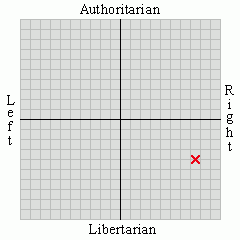
And for all the "One Nation" talk of this, it suits the libertarian-conservative Welshman in this corner. Though I have my qualms with some of the training "community organisers", protecting NHS spending and whatnot, there are some inherently conservative things in this manifesto. Take free schools (which should settle a few votes), freeing schools up, taking away the targets and looking for diversity and innovation - what's wrong with the postcode lottery if it leads to us finding a better way? I'm not sure how much there's a link between government and society in this manifesto, and I'm hoping they are made quite separate, but for people to do more and to organise themselves without government is certainly something I can support. A model of individuals controlling their own lives and doing things themselves, without government pretending it's a charity, organiser, planner, or anything else? Fantastic.

I was concerned that we'd lost conservative principles, that Cameron wasn't a conservative, and so on. Seeing this manifesto today, however much I'd like to see some of the main policies highlighted in there (but that's just a presentation issue), I know quite clearly who I should vote for. This manifesto should win the election; it sets out a different vision for the future. Whether people see that, overcome their prejudices, the "all the same" nonsense, fringe parties and so on, will probably decide this election.

Tuesday, 23 February 2010

Greece must not be bailed out

There's more and more talk, especially in the European circles, of the possibility of Greece defaulting on her sovereign debts, and because of that she might have to be bailed out.

Let's get to the causes here before we talk solutions - Greece has spend too much. It has, as a member of the eurozone, borrowed far too cheaply, and they've gone from budget surplus to 12.7% deficits (give or take some dodgy accounting).

Clearly then this is an issue of Greece spending too much - and it should cut back - not be funded in its profligacy. Perhaps the public sector workers will go on strike - it's their problem, their governments' irresponsibility. They've got used to too much spending, and have to return to normalcy at some point. If not, they'll go bust - and that will send an even more powerful message.

What does it say to Ireland, whose government has made the necessary cuts and austerity measures in order to avoid bankruptcy? The responsible bailing out the irresponsible? What does it say when the Eurozone actually breaks its own rules in order to save its own skin, just to stop it breaking up?

Economists talk of 'optimal currency areas'; the Eurozone was never one. Countries like Greece have shown that, enjoying German interest rates which overheated their economies. Now they are paying the price - and I don't think it will cause the eurozone to break up, but it would send a powerful message about currency unions - they don't work, except with very similar economies (take the USA).

Thank heavens the UK didn't join.

On Parliament and the role of MPs

Labour MP Natascha Engel:

But we are moving in totally the wrong direction. I don’t know how many times I hear people demanding a more consensual style of politics, asking us to put aside political affiliations and work for the good of the people that elected them. This is only making it worse.

After the expenses scandal, this view has become even more dominant. Yet the vast majority of us were elected only because we stood for a political party. In fact, Parliament is predicated on the very existence of political parties. It’s how we organise ourselves.

But our system breaks down when our political parties are not ideologically distinct. Today, we define our differences by dividing lines. We ask a small group of people — a focus group — what they care about, and then ask them what they want us to do about it. That’s not politics. That’s marketing. It’s turning us into admen and PR agents.

The politics of focus groups makes politicians reactive. We should lead, persuade and inspire. We should argue for what we think is right, even if popular opinion is against us. Leadership is about taking risks, even if that means losing our positions as a result.

Politics and politicians need to encourage big ideas and promote different ways of organising our society. Parliament should be a forum for clashing ideas again. And politicians need to rediscover that being an MP is about more than doing a job. It’s about being in a privileged position to put into practice deeply held beliefs and ideas.

When we debate parliamentary reform this week, we need to talk about getting back to first principles. Papering over the cracks won’t do any more. We need to tear down the flock wallpaper and fix the plasterwork underneath.

Well written, well thought out piece - read it. I think she's right - Parliament should be a place where ideas clash, MPs should be thinkers, legislators - as well as people who hold the executive to account.

The "expenses reforms" miss the point. I've already posted about why the new IPSA quango is wrong - in fact it subverts democracy further. The problem in this country is that the executive and the European Union hold too much power - and MPs aren't really sure what their role is.

They should be scrutinising legislation, coming up with ideas themselves - Parliament, the mother of all Parliaments, should be where great minds come together to really get the best solution.

Illiberal and intrusive

That's how I sum up the SNP's new plan to tackle obesity. Listen to this: it plans to stop restaurants serving 'large' portions, stop shops selling sweets near the till, only allow two-for-one offers etc on health products, 'advise' women on eating habits before they fall pregnant, and force councils to clean up more dog dirt 'to encourage exercise'.

What a load of illiberal tosh. State intervention to force people to be more healthy? Is this not Britain? The freedom-loving nation of individual responsibility? This is not an issue for governments to take responsibility for! It's a matter for individuals, if anything else wasn't.

Don't get me wrong, I think healthy is good. I keep myself in good shape because, well, I wouldn't mind living past 60, and bulging biceps look good. That's my choice. Other people don't follow it. The thought of me forcing someone else to get into shape if they don't want to twitches every bone in my body. The thought of government, with its monopoly of force, forcing everyone to be healthy nearly knocks me over.

There are other practical problems. What constitutes a 'large' portion? It seems too subjective to be written into legislation. What is 'near the till'? Shops vary in size. What are 'health products'? Couldn't retailers find ways around that one? Councils clearing up more dog dirt? That's an issue for local electorates to decide.

Why are we even in a country where such a proposal does not cause outrage? Why are we in a country which, once renowned for freedom, actually sees these proposals from as high a level as Scottish government ministers? I know socialists control Scotland, but this proposal is truly shocking.

Thursday, 18 February 2010

Government advertising

Government spending on advertising has risen by 40% in the last year. Yes, I've noticed. This new video from the TPA reminded me of it.


That's just DEFRA.

There are two others I don't like - the one about not leaving stuff visible to thieves (how about stop pretending victims of crime have themselves to blame and put the money into improving the police) and the science and maths one with the climate forecaster - "it's more of the same I'm afraid unless we do something about it" - with a terrible joke at the end - how about putting the money into improving education perhaps? And stop making political points (scientists study what's happening, not what to do, as far as I'm concerned).

And above all, they become incredibly annoying when you just get government adverts thrown at you on radio, TV, Spotify especially is a particularly bad one. Why are government adverts annoying? Because they haven't got to make money from adverts. The adverts are of benefit to no one, they just patronise people and annoy them. The theft one is both patronising and drains confidence in the police's ability to fight crime.

It's not the government's place to advertise and tell us how to behave anyway. Leave where I leave my stuff to me, how much I drink to me, what I do to me - and I can find out the information without government advertising, and take responsibility for my own life. And with the sort of fiscal hole we're in, £253 million on advertising should be one of the first things to go. Propaganda has no place in a free society.

Thursday, 11 February 2010

New quango is not the way to go about solving the expenses problem

No, we don't want another quango! That misses the point entirely! Trust rushed legislation to absolutely ruin our constitution altogether.

Parliament should be supreme. The IPSA will now be supreme. It's not accountable to anyone. It is not a British solution to the problem; the problem was overclaiming, and the solution is that the public want to know what their MP is claiming.

Not only this, but it's going to cost £6 million. £6 million! To put that into perspective, MPs overclaimed by £1 million. It's a normal governmental waste of money.

When will someone stand up, abolish this quango, and say that all we need is full transparency? Voters will be able to hold their MP accountable for what they claim. If they don't like it, MP is out. Simple. The voter should be the only regulator of the Commons, not IPSA.

Friday, 5 February 2010

Fail of the day

Douglas Alexander and Ed Miliband on Comment is Free.
The real question facing Britain is not how to nudge people but how to give them power over their own lives. The need for collective action is clear
Make your mind up, power over their lives i.e. less government or collective action i.e. more government (and less power over their own lives).

Labour just don't have a clue.

12, nearly 13 years of more government, it's failed, it's clearly caused problems, and they want to expand government further.

Because that's logical.